

Dyslexia and Dyscalculia assessments in Loughborough
When a child struggles with reading, writing, or maths, it creates a confusing landscape for parents and teachers. You may have done your research and decided that a dyslexia or dyscalculia assessment would be useful. But where do you turn? Who can officially provide a dyslexia and dyscalculia diagnosis?
A professional dyslexia or dyscalculia assessment isn’t just a simple test. It is an extensive investigation into a student’s thought processes, how they manage information, and how they perform across a range of areas. For families in Loughborough, understanding who to turn to is the first step towards getting the right support.
Specialist Assessors vs. Educational Psychologists
In the UK, two types of professionals can officially diagnose dyslexia and dyscalculia. While both are highly qualified, they approach the process from different angles.
1. Specialist Teacher Assessor (Level 7)
A Specialist Teacher Assessor is usually an experienced educator who has undertaken postgraduate training (Level 7) in Specific Learning Difficulties (SpLD). To assess for both dyslexia and dyscalculia, they must hold qualifications in both areas.
When searching for a local assessor in the Loughborough area, ensure the assessor holds a current APC (Assessment Practicing Certificate). This is the “gold standard” that ensures reports are future-proofed and valid for Disabled Students’ Allowance (DSA) and exam access arrangements. APCs are renewed every three years through a rigorous process to ensure all SASC (SpLD Assessment Standards Committee) guidelines are met.
2. Educational Psychologist (EP)
An Educational Psychologist holds a doctoral-level degree and is registered with the HCPC. They take a broader view, identifying global cognitive issues or social-communication difficulties. They offer a holistic perspective, and their reports vary greatly in structure.
Which should you choose?
If you suspect specific struggles with literacy or numeracy, a Specialist Assessor offers a highly focused, cost-effective, and efficient route. If you suspect other complexities, like ADHD, anxiety, or global developmental delays, an EP may be more suitable.
What Does a Dyslexia or Dyscalculia Assessment Involve?
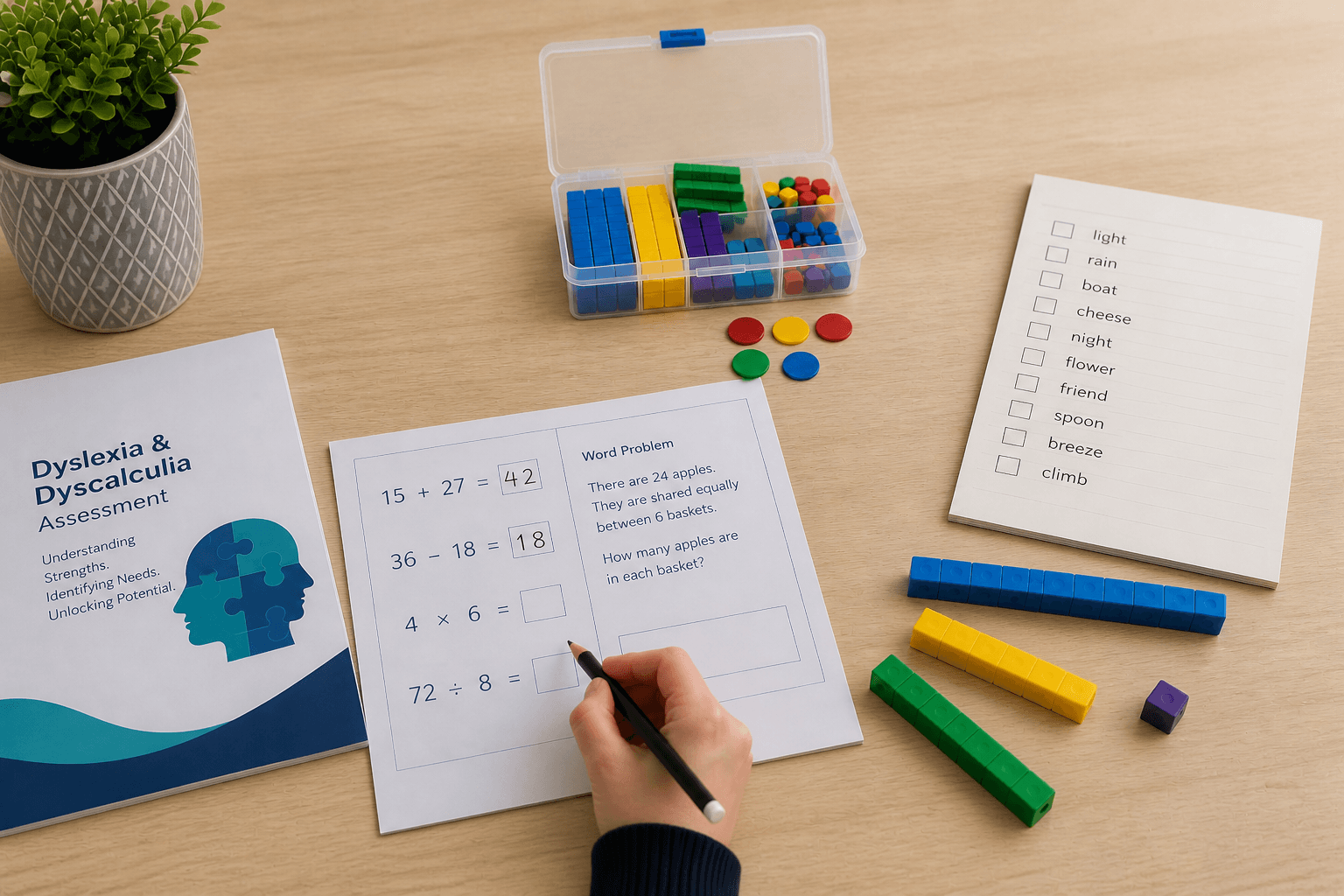
An assessment is a rigorous “brain workout” lasting several hours. The session will explore a wide range of elements, usually including:
Cognitive Processing: The “internal engine,” including Working Memory and Processing Speed.
Phonological Awareness: The ability to identify and manipulate sounds within words.
Attainment: Testing of reading, spelling, writing, or mathematical fluency.
Language Skills: Evaluating a child’s expressive and receptive abilities.
A Quick Note About Screeners
Many schools in the Loughborough area use dyslexia or dyscalculia screeners. While helpful in identifying students who may otherwise have gone under the radar, it is vital to understand their limits:
The Pros: They are quick and excellent for “flagging” children who need immediate intervention or may benefit from a full diagnostic assessment.
The Cons: They can produce “false negatives” for high-ability children who have learned to “mask” their difficulties. Because they are usually run on a computer, individual strategies and coping techniques are not considered.
Summary: A screener is a compass, not a map; it indicates risk! Only a full diagnostic assessment provides a formal diagnosis.
Empowering Your Child’s Future
A formal assessment is more than just a process for a diagnosis; it is a roadmap. If you are based in the Loughborough area, a formal dyslexia or dyscalculia assessment may help to provide the clarity needed to unlock the “why” and “how” of your child’s learning.
It can unlock what is needed in terms of specific teaching strategies and exam access arrangements. By understanding how a student learns, we can shift the focus from their struggles to their untapped potential. An assessment may lead to a diagnosis or it may not, but it will help you, your child, and their teachers understand why they are having difficulties so that support can be targeted.
If you are based in Loughborough and your child appears to be having unexplained difficulties, a discussion with a specialist assessor may be useful in determining whether an assessment is needed. Contact Education Pitstop for more details.