
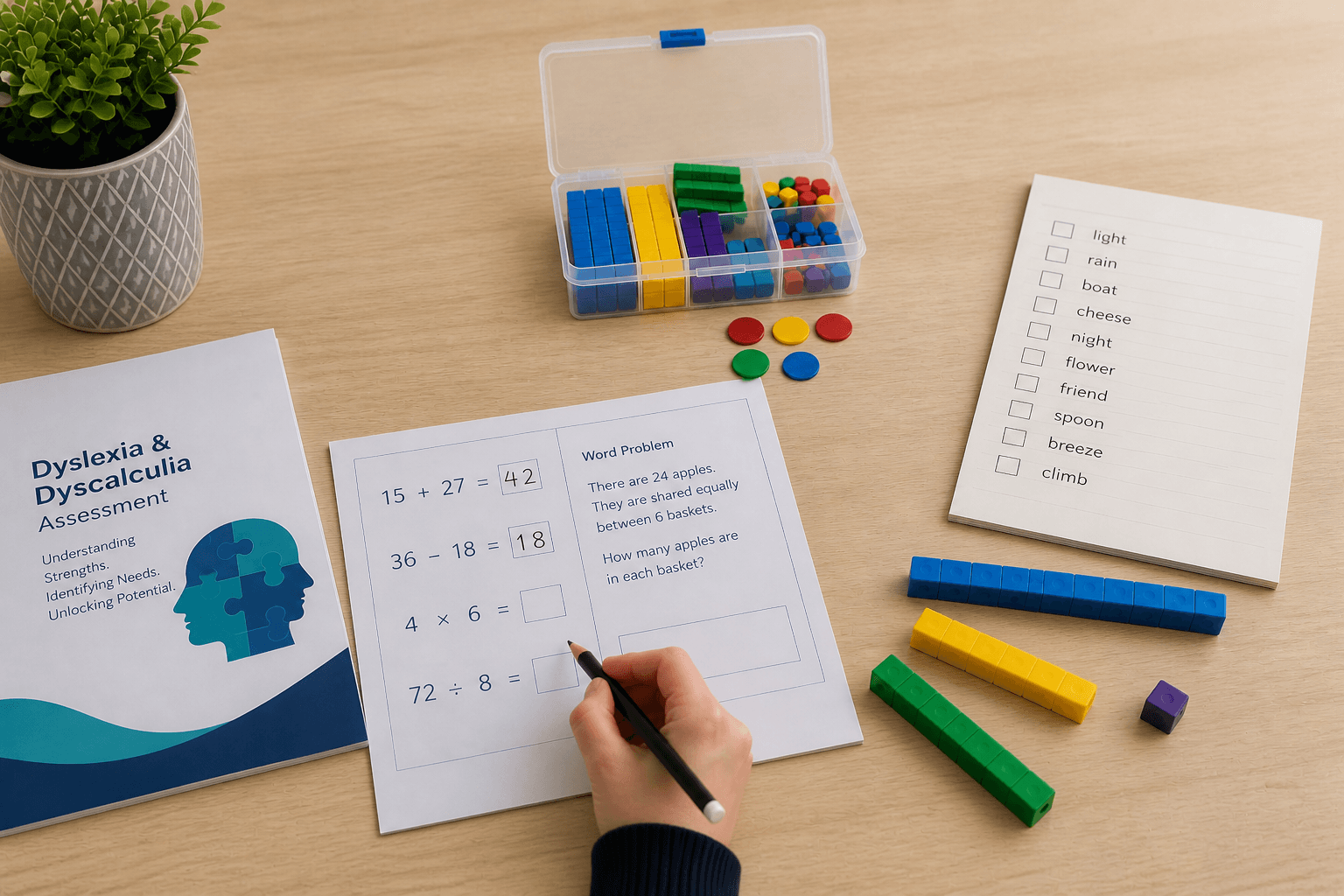
Understanding Assessment and Tuition Fees
When exploring support for a family member or yourself, understanding specialist dyslexia costs can sometimes cause a moment of hesitation. It is completely natural to wonder why diagnostic assessments and expert tuition are priced as they are, especially when compared to education, which is typically free, and general tuition costs as advertised by local tutors.
To understand the price of specialist support, it helps to look behind the scenes at the strict regulatory framework, ongoing expenses, and high-level training required to officially practise in this field.
The Foundation of Expertise: Level 7 Qualifications
Unlike general tutoring, specialist teachers and assessors hold postgraduate qualifications.
- Master’s Level Training: Professional assessors must hold a Level 7 qualification (equivalent to a Master’s degree) in the area they wish to assess. This involves intensive university-level study, rigorous practical training, and supervised hours. A separate Level 7 qualification is required for dyslexia and dyscalculia, usually involving double the fees and training time.
- Financial Investment: Obtaining a Level 7 qualification costs thousands of pounds in tuition fees alone, alongside months of additional clinical practice, understanding the impacts of research in the field and plenty of essay writing.
Why Specialist Dyslexia and Dyscalculia Costs Include Mandatory Overheads
An independent dyslexia or dyscalculia specialist operates like a small, highly regulated clinic. To practise legally, ethically, and with up to date guidelines, professionals must pay several mandatory recurring fees every year:
- Professional Memberships & Practising Certificates: Assessors must hold an Assessment Practising Certificate (APC). They must also maintain membership with at least one professional body like the Dyslexia Guild, Patoss or the British Dyslexia Association (BDA). These require an annual membership fee, proof of continuous professional development (CPD) and APC renewal every three years: a detailed CPD log with specific requirements, submission of anonymised reports which must follow a structured and recently updated format.
- Data Protection & Compliance: Because we handle data relating to our students, including cognitive and medical data, we must register with the Information Commissioner’s Office (ICO) and pay annual data protection fees.
- Safeguarding: An annual subscription with the Disclosure and Barring Service (DBS) Update Service ensures student safety, allowing partnership schools and parents can carry out immediate and fully up to date enhanced DBS checks.
- Specialist Insurance: Comprehensive public liability and professional indemnity insurance are required to protect both the practitioner and the client.
The Hidden Costs of Testing Materials
The physical tools used in an assessment are not standard worksheets; they are highly restricted, scientifically validated clinical instruments.
- Restricted Access: Only qualified professionals are permitted to buy these test batteries. Multiple test batteries are required for a dyslexia and dyscalculia assessment.
- High Purchase Test Costs: A single core test kit (such as the CTOPP, WIAT or IDS2) costs hundreds of pounds to buy.
- Per-Client Costs: Every single assessment requires a new test booklet or a digital scoring licence. These consumable booklets cost significant money per client, meaning a portion of your fee goes directly to the test publishers before the assessment even begins.
The Invisible Hours
When you pay for a fifty-minute tuition session or a four-hour assessment, you are only seeing a fraction of the actual time dedicated to your case.
- Tuition: For every lesson, a specialist spends significant time creating bespoke resources, reviewing past performance, documenting progress and planning personalised future lessons. No two lessons are ever the same.
- Assessment: A four-hour face-to-face assessment requires up to 3 hours of pre-assessment questionnaire analysis, parent interviews and gathering information from school; an additional 1 to 2 hours are required to for psychometric scoring and calculating important statistics which help to validate and explain the relevance of the test; this is followed by many hours of report writing, proof reading and preparing documents ready to send to parents. No two assessments use the exact same test batteries and no two reports are alike. A report is totally personalised for each student, highlighting their strengths and weaknesses and providing specific recommendations for the various settings that they will encounter.
Managing Specialist Dyslexia Costs: Check for an APC
Prices vary between specialists, but it is vital to check exactly what you are paying for. If you require a lifelong report that can be used to secure vital support – such as the Disabled Students’ Allowance (DSA) at university – the assessor must hold a valid Assessment Practising Certificate (APC). A cheaper report from an uncertified individual may end up costing you more in the long run.
Putting it into Perspective: Everyday Services vs. Specialist Care
We rarely hesitate to pay for regular lifestyle services, yet when compared as an hourly rate, specialist dyslexia or dyscalculia teaching and assessments represents extraordinary value.
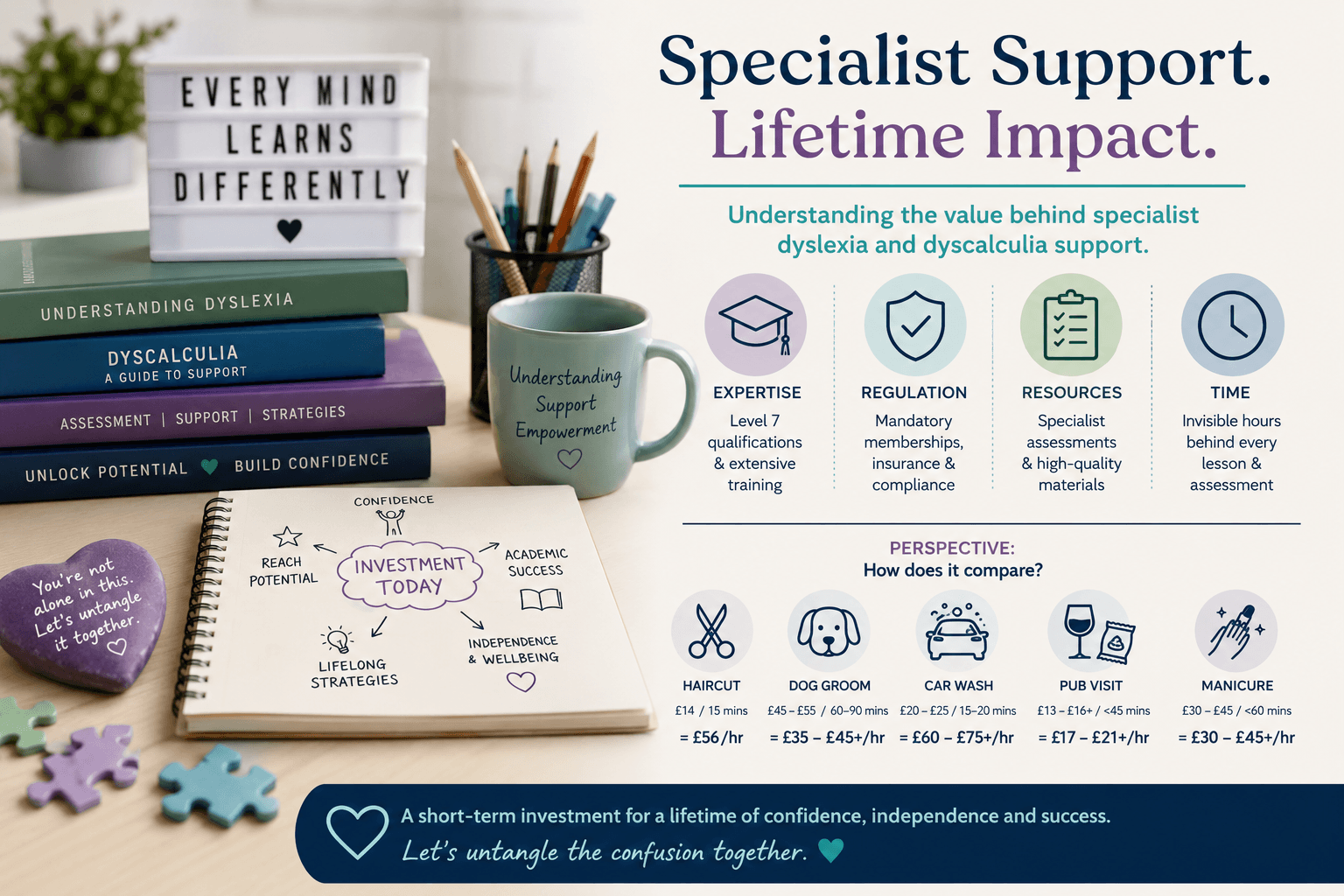
- The Haircut: A standard local men’s haircut costs around £14 for 15-minutes. When you look at the clock, that scales up to an hourly rate of £56 per hour. A standard ladies’ cut and blow-dry averages roughly £39.50 for a 45-minute appointment, which sits at over £52 per hour. These are recurring, lifelong maintenance costs that we budget for without a second thought.
- The Dog Groomer: A full groom for a medium-sized dog (such as a Cockapoo or Spaniel) at a local salon typically costs between £45 and £55 and takes around 60 to 90 minutes. This equates to an hourly rate of £35 to £45+ per hour. Like hair appointments, this is an ongoing expense required every few weeks/months.
- The Car Wash: Getting a standard “In & Out” clean at a local hand car wash costs roughly £20 to £25 for a 15-to-20 minute job. Scaled up to an hourly rate, this represents a staggering £60 to £75+ per hour for manual labour.
- The Quick Pub Visit: Pop into a local pub for just one round consisting of a pint of beer, a glass of red wine, and a packet of crisps, and the bill will instantly come to £13 to £16+. This is a casual, fleeting indulgence that lasts under 45 minutes, yet we might spend it multiple times a month without a backward glance.
- The Manicure: A standard gel or nail treatment at local beauty salons average £30 to £45 for an appointment that takes under an hour, meaning you could regularly pay an hourly rate of £30 to £45+ every few weeks.
These little treats are wonderful and no one is denying that they are well worth the money. However, it is vital to contrast these short-term, recurring lifestyle choices against a long-term educational investment.
A Lifetime Investment, Not a Lifetime Cost
The biggest difference between specialist dyslexia costs and lifestyle services is the timeline:
- Assessments are a one-off cost: A diagnostic assessment happens once. A report from an APC-holder remains valid for a lifetime, unlocking DSA funding at university and accommodations in the workplace.
- Tuition is short-term and targeted: Unlike a lifetime of monthly hair or nail appointments, specialist tutoring is a finite project. I offer tutoring in focused 5-week blocks with no commitment to buy more.
Realistically, most students require several blocks (often lasting around 4-6 months) to untangle their learning confusion, rebuild confidence, and make meaningful progress. However, once those strategies are mastered, the tuition stops. When you even out that short-term cost over a student’s entire school, university, and working life, it becomes an incredibly reasonable investment in their future.
Think of it this way: a child or adult who masters these essential learning strategies will carry them for the next 50 to 60 years. When you spread the cost of a temporary six-month block of targeted tuition across a student’s entire academic and professional lifetime, the actual cost equates to mere pennies a day. It is a finite, short-term expense that pays compounding dividends for decades to come.
Let’s Untangle the Confusion Together
Investing in professional educational support is a powerful step towards unlocking potential, rebuilding self-esteem, and building a toolkit for lifelong success. Because every individual’s learning profile is completely unique, the best way forward is an informal chat about your specific needs.
If you would like to discuss booking an APC-certified diagnostic assessment, or if you want to find out more about targeted, specialist tuition for your child, I would love to hear from you.
You can reach out directly via my Contact Page. Let’s take the first step together to turn learning confusion into lasting confidence.